Contents
(1) Macro Backdrop
(2) Crypto Market Moves
(3) Crypto Fund Performance
(4) Positioning and Flows
(5) Takeaways
1. Macro Backdrop
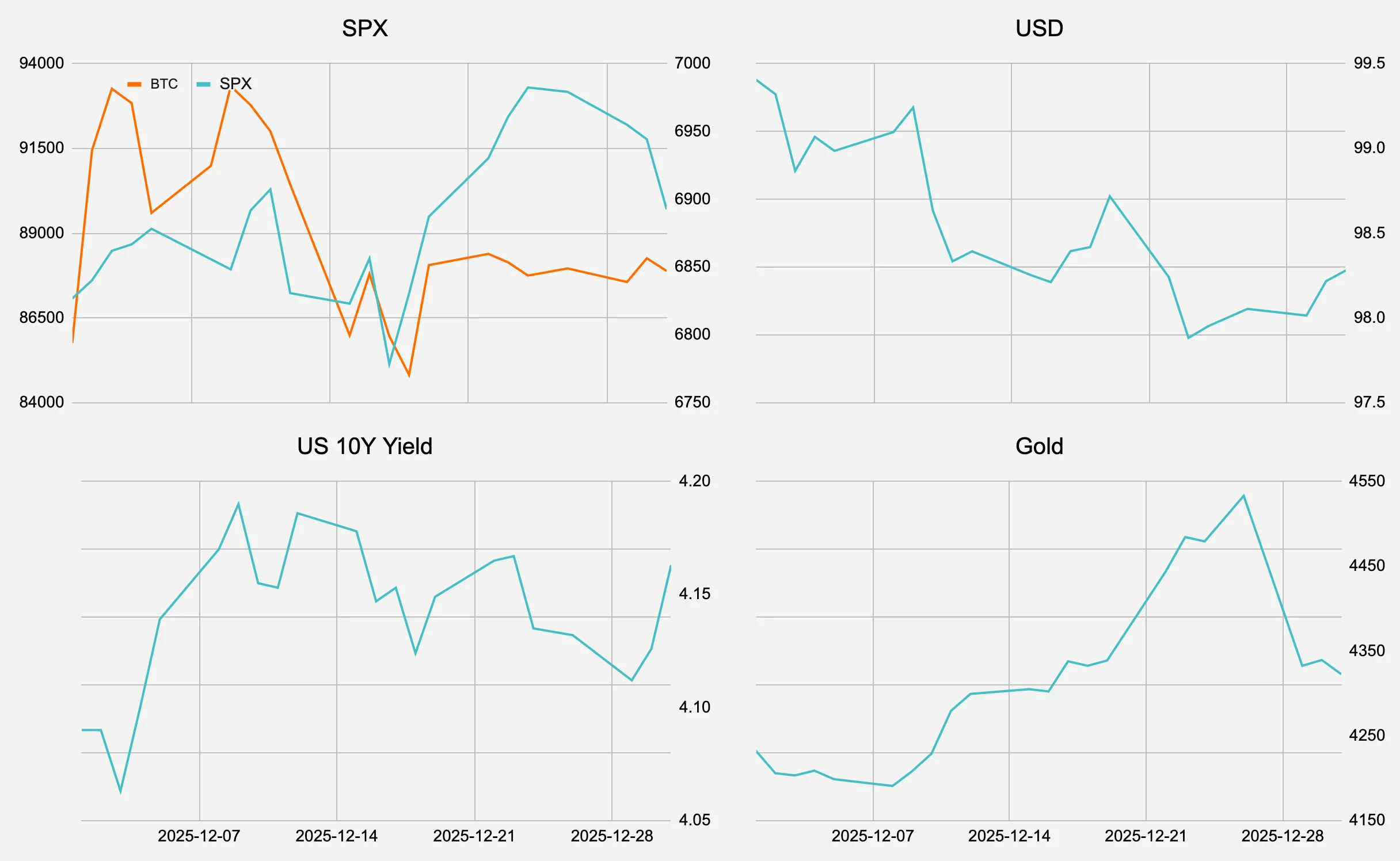
December opened cautiously as markets entered the final stretch of the year with conviction thin and positioning light. Rates sold off early, equities traded heavy, and risk appetite remained fragile following November’s drawdown. With the Federal Reserve in blackout, markets were forced to trade largely off geopolitical headlines and policy signalling. Trump’s indication that Kevin Hassett was effectively his preferred next Fed Chair added to policy uncertainty, while US–Russia–Ukraine negotiations continued without resolution. As delayed data releases resumed, they failed to restore confidence, with investors increasingly focused on the December FOMC for directional clarity.
The FOMC delivered a widely expected 25 bp cut, lowering the target range to 3.5–3.75%, but the tone proved more hawkish than markets had anticipated. Two dissents and language emphasising conditionality raised the bar for further easing, reframing expectations away from a smooth easing path. Rates initially rallied before selling off again as the message was digested. Global policy divergence added to volatility: the Bank of England cut as expected, while the Bank of Japan surprised with a 25 bp hike, its first meaningful tightening in decades, triggering a broader duration sell-off.
Figure 1: December price action
Source: Presto Research
Geopolitical risk remained persistent through month-end, from US actions around Venezuelan oil shipments to continued developments in Ukraine. Into the final week, commodities surged, with gold, silver, and copper making new highs, while equities faded modestly and the dollar softened. By year-end, macro markets reflected a familiar pattern: policy easing underway, but confidence constrained by inflation risk, geopolitics, and uneven global growth.
2. Crypto Market Moves
Crypto stabilised in December following November’s sharp drawdown, but failed to re-establish upside momentum. Bitcoin rebounded from the mid-$80k range into the low-$90k area early in the month before slipping back into choppy consolidation. Ethereum recovered from sub-$3k levels toward the low-$3ks but remained capped below key resistance. Volatility retraced as spot recovered, though skew stayed firmly biased to the downside.
Early December price action was dominated by defensive positioning ahead of the PCE release and the FOMC. As the Fed delivered and year-end liquidity thinned, markets became increasingly range-bound. By late December, BTC hovered between the high-$80k and low-$90k range, while ETH remained below mid-$3k levels. The market tone reflected capital preservation rather than directional conviction, closing the year in a holding pattern rather than a recovery phase.
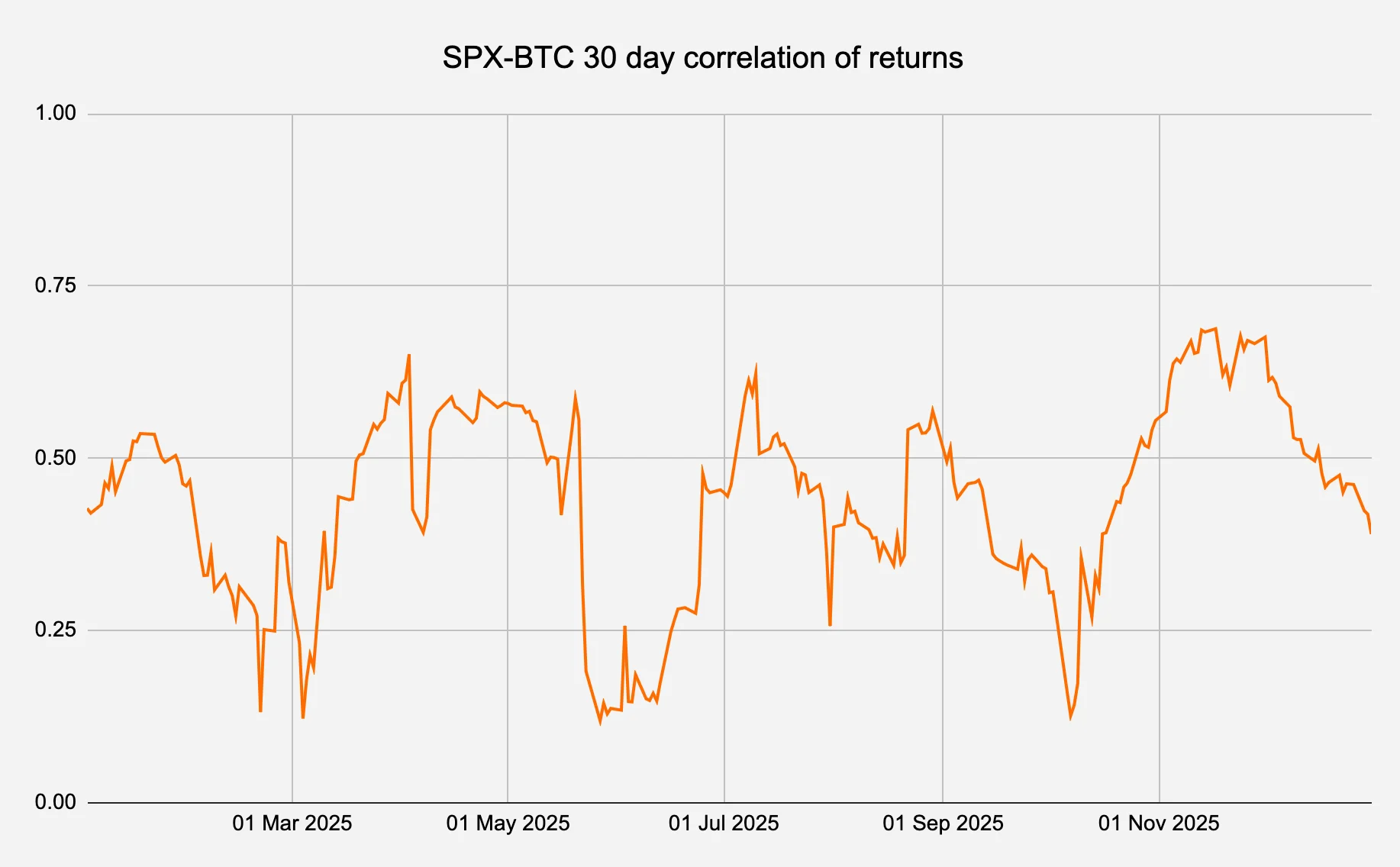
Figure 2: Correlations fell sharply in December
Source: Presto Research
Derivatives flows reinforced this caution. December opened with strong demand for short-dated downside, including BTC 75k puts and ETH 2k puts, alongside longer-dated June BTC protection. As spot rebounded, flows rotated into neutral-to-defensive structures. December calls were sold, BTC risk reversals printed around the 90k–98k range, and selective ETH upside was expressed through late-December 4.8k calls. Post-FOMC, positioning remained measured. There was no aggressive chase higher despite spot stability, and downside hedging persisted into year-end. Volatility stayed contained, skew remained firm, and flows suggested traders preferred to carry protection into January rather than express fresh risk.
3. Crypto Fund Performance
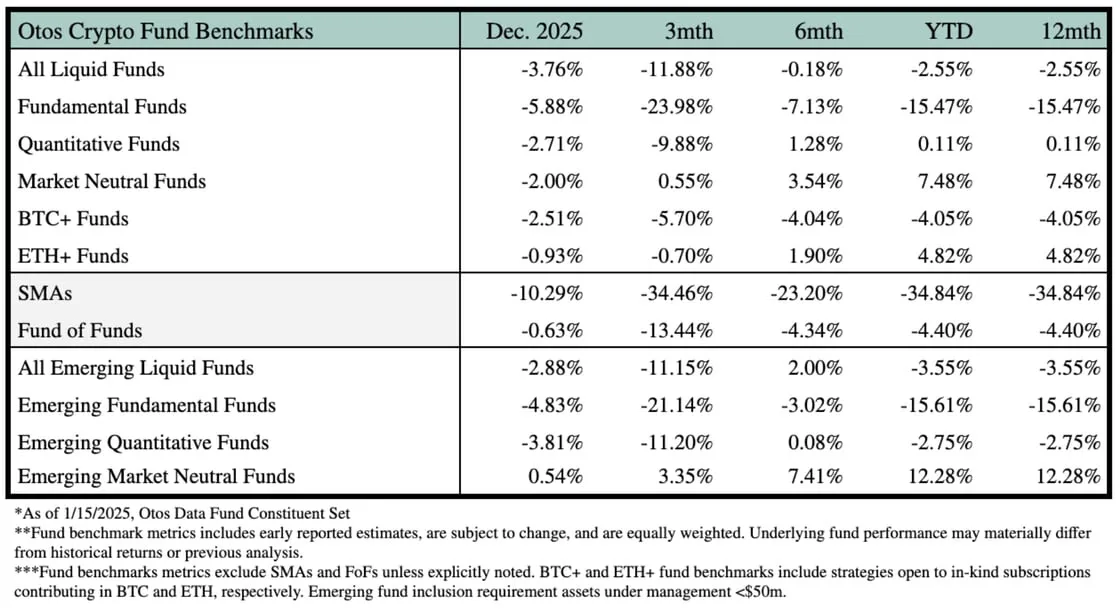
December proved challenging for crypto hedge funds, though losses were more controlled than in November. Based on preliminary Otos estimates, all liquid crypto funds declined an average of -3.76% on the month, reflecting stabilising but still defensive market conditions.
Performance dispersion across strategies remained instructive:
Fundamental funds declined -5.88%, continuing to struggle with limited upside follow-through and residual directional exposure.
Quantitative funds fell -2.71%, reflecting reduced volatility and thinner year-end liquidity.
Market neutral funds lost -2.00%, outperforming directional strategies but facing pressure as spreads compressed and opportunities narrowed.
BTC+ funds declined -2.51%, while ETH+ funds fell -0.93%, consistent with relative resilience in ETH over the month.
Figure 3: December was a tough month across all strategies
Source: Otos Data
On a year-to-date basis, the divergence across strategies remained stark. Fundamental funds finished 2025 down -15.47%, quant strategies eked out a modest +0.11%, and market neutral strategies ended the year up +7.48%, reinforcing the structural advantage of lower-beta and relative-value approaches in a volatile, stop-start regime.
Among smaller managers with under $50m AUM, emerging market neutral funds again stood out. While emerging fundamental and quant funds declined -4.83% and -3.81% respectively in December, emerging market neutral strategies gained +0.54%, extending their full-year return to +12.28% and outperforming larger peers.
4. Positioning and Flows
Market-makers reported a nuanced picture of December positioning. Activity was dominated by proprietary trading firms and hedge funds, which were close to flat on a net basis, while net selling came from miners, financial intermediaries, and retail aggregators. Net buying was driven by venture funds, corporates, and institutional wealth managers.
Across cohorts, ETH emerged as the most bought asset, while BTC was the most sold. Hedge funds were net sellers of BTC and SOL over the month but accumulated ETH and selected alts, including HYPE, CC, LIT, and AAVE. Institutional wealth managers, by contrast, were net buyers of BTC, SOL, and LINK, particularly into the final days of the year, suggesting positioning for a potential January reset.
Flow timing mattered. Buying peaked in the first week of December during BTC’s rebound above $93k, while selling intensified mid-month as the rally stalled near $94k. Hedge funds shifted from net sellers into net buyers in the final two weeks, while institutional buying accelerated into year-end, particularly in SOL.
At the portfolio level, these dynamics resolved into a familiar December outcome: limited upside capture, controlled drawdowns, and a preference for balance sheet preservation. The month reinforced the growing separation between narrative interest and capital deployment. While forward-looking themes around infrastructure, integration, and survivability continued to dominate discourse, capital remained selectively deployed, with positioning increasingly shaped by liquidity, risk management, and year-end constraints rather than thematic conviction.
5. Takeaways
December closed the year with stabilisation, not recovery. Macro markets moved toward easing, but conditional policy messaging, geopolitical risk, and global divergence kept confidence restrained. Crypto absorbed these dynamics with reduced volatility and tighter ranges, but without the catalyst required to re-ignite risk appetite.
For funds, the month underscored the defining lesson of 2025: adaptability matters more than narrative alignment. Directional strategies continued to face headwinds, while market neutral and lower-beta approaches preserved capital and compounded steadily through volatility. Positioning into year-end was cleaner but cautious, with protection carried forward rather than unwound.
As 2026 begins, the market enters January with volatility contained, leverage reduced, and expectations reset. The foundation is firmer than it was in November, but conviction remains conditional. The next phase will depend less on belief and more on follow-through: in policy, in flows, and in whether stabilisation can evolve into durable risk-taking rather than another false start.