Contents
(1) Macro Backdrop
(2) Crypto Market Moves
(3) Crypto Fund Performance
(4) Positioning and Flows
(5) Takeaways
1. Macro Backdrop
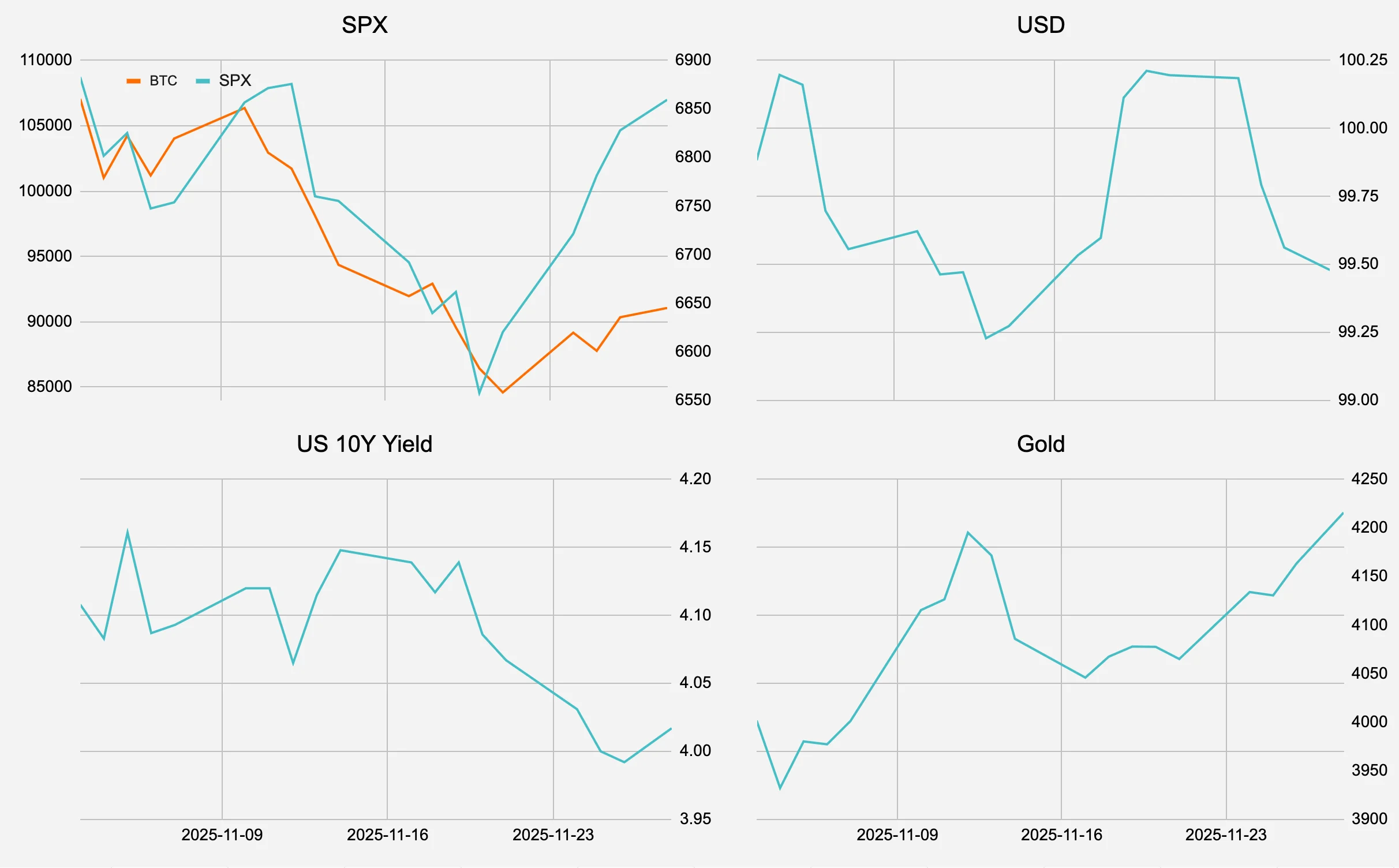
November opened under sustained pressure as the US government shutdown extended beyond one month, freezing key data releases and forcing markets to trade on incomplete information. Thin liquidity amplified day-to-day swings. Early optimism around China’s suspension of rare-earth export controls and softer chip-sector investigations faded quickly as geopolitical and fiscal risks re-emerged. Beijing warned Tokyo of “substantive retaliation” over Taiwan comments, UK fiscal uncertainty resurfaced, and Japan reported a sharper-than-expected GDP contraction.
Rates oscillated amid the information vacuum, the dollar stayed firm, and equities struggled to establish direction. The shutdown formally ended mid-month, but uncertainty lingered as investors awaited delayed labour and inflation prints. Fed communication turned mixed. Collins signalled a high bar for further easing, while Williams leaned more dovish and left room for near-term adjustments. Into Thanksgiving week, NVDA earnings, an accidental early release of UK fiscal projections, and renewed geopolitical noise around Ukraine kept volatility elevated. By month-end, with the Fed entering blackout and Trump hinting at his preferred Fed chair, markets tilted risk-off again as curves sold off and equities faded.
Figure 1: November price action
Source: Presto Research
2. Crypto Market Moves
Crypto traded heavy throughout November, tracking weaker macro sentiment and sustained institutional outflows. Bitcoin fell from above $105k into the low $80k region before stabilising, while Ethereum retraced from near $4k toward $2.6k. Solana underperformed, declining nearly 30% on the month. By month-end, BTC consolidated near $86.5k and ETH around $2.8k ahead of the delayed PCE release that would shape expectations for the December FOMC.
ETF flows remained a persistent headwind. The iShares Bitcoin Trust recorded over $2.2bn in net outflows by November 24, the largest monthly total on record, reinforcing the ongoing erosion in institutional demand. Relief rallies were brief and shallow, capped by broader weakness in equities and shutdown-related uncertainty.
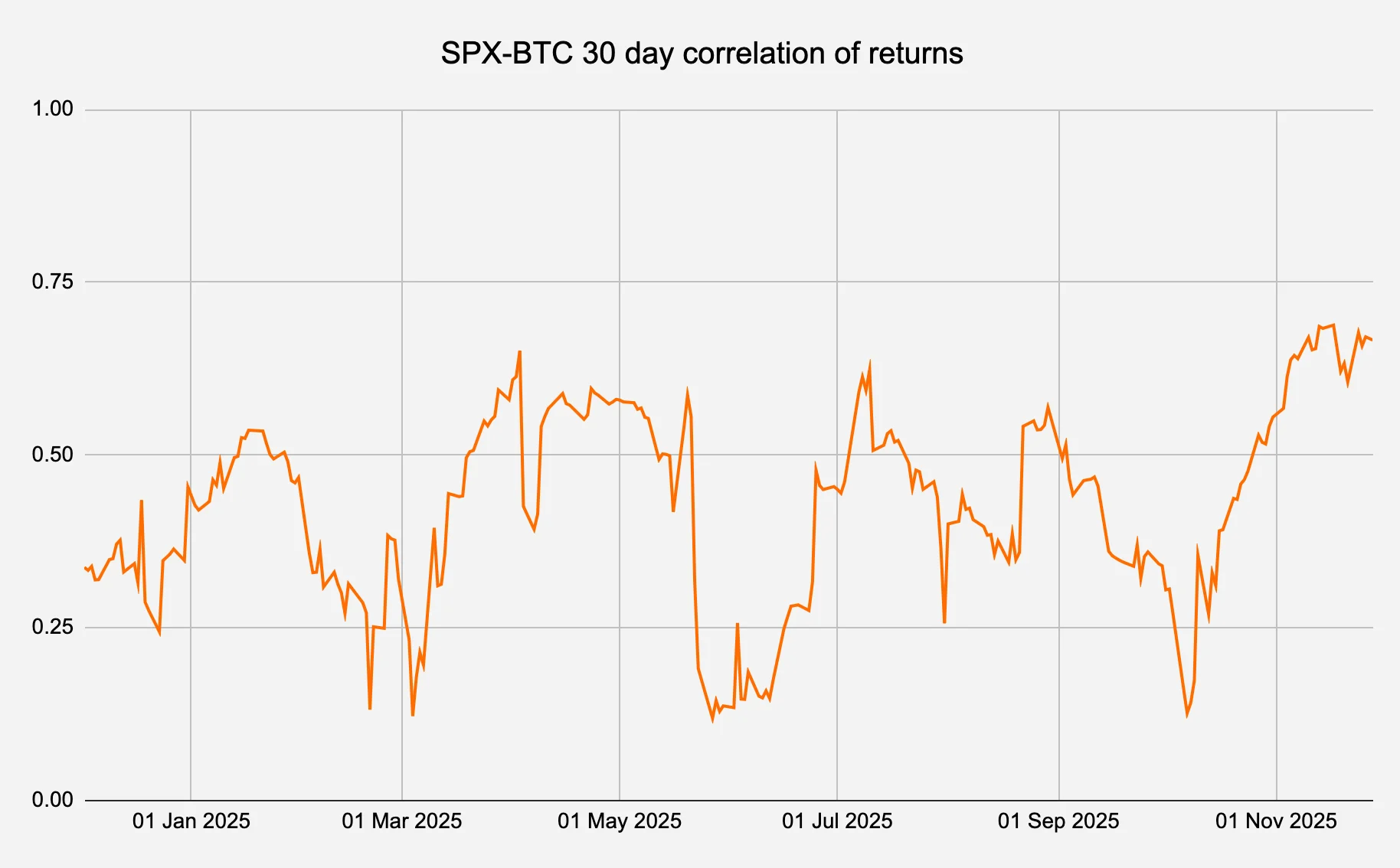
Figure 2: Correlations continued to increase in November
Source: Presto Research
Derivatives markets reflected defensive positioning throughout. Front-end volatility widened on sell-offs, and skew remained firmly put-heavy as traders sought protection. Early flows focused on short-dated BTC and ETH downside, while mid- to late-month activity shifted toward deeper OTM BTC puts and downside risk reversals as spot continued to slide. Activity peaked around US Thanksgiving, with elevated Paradigm volumes and large structured trades, before markets reset positioning lower into month-end.
3. Crypto Fund Performance
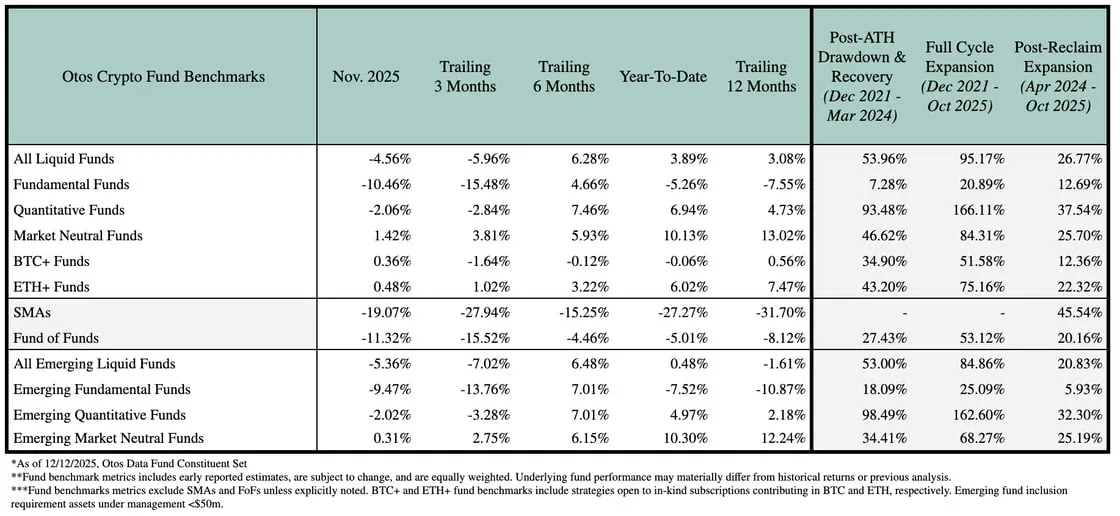
November proved challenging for crypto hedge funds as sharp spot drawdowns and elevated volatility caught positioning off-guard. Based on preliminary estimates from the Otos constituent set, all liquid crypto funds declined an average of -4.56% on the month.
Performance dispersion remained pronounced across strategies:
Fundamental funds fell -10.46%, reflecting heavier directional exposure amid the sell-off.
Quantitative funds declined -2.06%.
Market neutral funds gained +1.42%.
SMAs underperformed significantly at -19.07%.
FoFs also underperformed down -11.32%.
Figure 3: November caught funds off-guard
Source: Otos Data
Among major assets, BTC fell roughly -17.5% in November, ETH lost over -22%, and SOL dropped nearly -29%. Most large-cap assets turned negative year-to-date, with the notable exceptions of select outliers such as HYPE and Zcash.
Figure 3 presents the November benchmark table alongside three allocator-focused performance windows. The Post-ATH Drawdown and Recovery phase highlights capital preservation and adaptability through prolonged stress. The Full Cycle Expansion phase contextualises long-run compounding across regimes. The Post-Reclaim Expansion phase isolates performance in a predominantly risk-on environment, offering insight into upside capture and scalability once recovery effects fade.
4. Positioning and Flows
Manager sentiment remained defensive throughout November. The combination of macro uncertainty, ETF outflows, and sharp spot declines reinforced a cautious posture across discretionary and systematic managers. The October flash crash continued to act as a narrative reset, forcing renewed scrutiny of risk frameworks, liquidity assumptions, and portfolio construction.
Despite the difficult tape, several forward-looking themes gained prominence in manager discussions. Prediction markets emerged as a key area of interest, viewed as event-driven venues capable of sustaining liquidity and generating uncorrelated alpha. Market makers, data providers, and hedge funds are increasingly exploring structured participation, with early-stage capital raising expected to accelerate into 2026.
The convergence of DeFi and TradFi remained another central focus. Expectations for wrapped equities, on-chain funds, and potential crypto IPOs in 2026 continue to build, alongside opportunities to arbitrage spreads between on-chain and off-chain venues as assets migrate on-chain. Vaults also drew increased attention as a capital-raising mechanism, particularly for accessing non-accredited or alternative investor bases. While some implementations have succeeded, concerns around leverage loops, under-collateralisation, and compliance remain front of mind. Finally, debates around L1 valuations intensified, reflecting a deeper divide over whether blockchains should be valued as businesses or as emergent jurisdictions, a framework that increasingly shapes longer-term capital allocation.
5. Takeaways
November marked a decisive shift toward risk aversion across global markets. A prolonged US government shutdown, mixed Fed signalling, and escalating geopolitical noise weighed on sentiment, while delayed data releases prolonged uncertainty. Crypto absorbed the pressure through sharp spot drawdowns, record ETF outflows, and persistently defensive derivatives positioning.
For funds, the month underscored the importance of adaptability and capital discipline. Directional strategies struggled, while market neutral and more systematic approaches again demonstrated resilience. As December approaches, positioning is cleaner but cautious. Elevated volatility, firm downside skew, and unresolved macro risks suggest a fragile environment, even as structural themes around market infrastructure, product convergence, and valuation frameworks continue to take shape beneath the surface.